Sunday, February 26, 2012

The Boy Who Cried Wolf

A number of political commenters have compared the current Republican contestants unfavorably with Barry Goldwater. The current crop, we are told, are religious nutcases, or possibly pretending to be. Goldwater, on the other hand, was an intelligent and reasonable man, even if not on the right side of every issue.

I have been reading my parents' autobiography, and recently got to the Goldwater campaign. Their description fits my memory. What we were being told then—by people almost none of whom could have done a competent job of explaining Goldwater's positions or the arguments for them—was that he was a dangerous madman. There was even a piece by some large number of psychiatrists, none of whom had ever examined the candidate, explaining how crazy he was. And the TV ad with the little girl, the countdown, and the mushroom cloud.

A while back I read an article attacking Bjorn Lomborg, an articulate  critic of much of the current environmental orthodoxy. It included a respectful reference to the late Julian Simon. Simon,  criticizing the population  orthodoxy, was making reasonable arguments, some of which turned out to be right. Lomborg, on the other hand ...  .

I remember that fight too—I contributed a chapter on the concept of optimal population to one of Julian Simon's books. Back when he was the front line of opposition to the then current orthodoxy, he got the same treatment Lomborg got a decade or two later.

I am not competent to judge the  climate science behind global warming, but I am suspicious of orthodoxies pushed relentlessly in the popular media, orthodoxies that claim that everyone competent agrees on an urgent problem which requires drastic action immediately if not sooner. I remember when we were being assured that it was simply a scientific fact that overpopulation was the cause of poverty and a near term threat to our own well being, if not survival. Also when we were assured that the only way to get the poor countries of the world up to our level was central planning, if possible supported by generous foreign aid.

When I see news headlines about global warming having shrunk horses to the size of cats, along with a picture comparing a cat sized horse to a modern Morgan—you have to read down a bit to discover that the ancestral horses shrank to the size of cats from the size of dogs, from 12 pounds to 8 1/2 pounds, and spent tens of thousands of years doing it—I suspect that what I am seeing is driven at least as much by what people want other people to believe as by the evidence for believing it.

Of course, going back to the beginning of this post, it's entirely possible that some of the Republican candidates are religious nutcases. With the possible exception of Ron Paul, none of them strikes me as someone I would be comfortable with as president. 

But after being told, time after time, that everyone competent to judge agrees with whatever views are currently fashionable with the academic and media elite, reasonable people stop believing it. 

Which brings me back to the title of this post.

Saturday, February 25, 2012

Richard Lindzen on Global Warming

Via a link from Eric Raymond, I've just been reading a presentation by Richard Lindzen, an MIT climate scientist critical of  current global warming arguments. His basic claims:

1. The direct effect of a doubling of atmospheric CO2 should be about a one degree C increase in global temperatures. The substantially larger effect projected in the IPCC reports depends on positive feedbacks in their models.

2. The atmosphere is a sufficiently complicated system so that predicting feedback effects on the basis of theory is difficult or impossible. Insofar as the feedbacks can be estimated empirically, they appear to be negative, not positive.

3. The historical evidence shows about a one degree increase from the past doubling. In order to make that consistent with the models it is necessary to include in the models additional features to explain a lower increase than would otherwise be predicted.

Interested readers should follow the link and look at the presentation themselves, both because my summary may not be entirely accurate--it's based on a single reading--and because there is a lot more there. 

I do not know enough about climate science to judge the argument on its merits. Lindzen sounds convincing, but it would be nice to see what sort of rebuttals people who disagree with him can offer—perhaps some readers can offer links to such. As I have commented in earlier posts, my own criticism of current global warming arguments and policy is based on the economics not the climate science. I have yet to see any convincing reason to believe that an increase in temperature of the magnitude suggested by the IPCC reports would have net negative consequences, let alone catastrophic ones. Apropos of which ... .

Human settlement and agriculture are currently limited by cold not by heat—the equator is populated, the poles are not. If global temperatures go up, more land in the northern hemisphere should become warm enough for human purposes. How big is the effect—by how many miles does the temperature contour shift? I recently did a very rough back-of-the-envelope calculation in response to someone online suggesting that the effect was larger than I was assuming, and concluded he was correct. 

I estimated the rate at which temperatures change as you move north from a page showing that day's maximum temperatures in different parts of the world. Assuming the rate of change is uniform and about the same for maximum, minimum, and average, a three degree C increase in temperature represents a shift of climate contours by more than two hundred miles—enough to more than double the effective area of Canada. Hopefully some reader can point me at a more accurate estimate, but I think that's sufficient to suggest the scale of the effect.

Freeman Dyson, in The Scientist as Rebel, argues that increased CO2 should have a larger effect on temperatures in colder areas. The argument is fairly simple. Water vapor is a strong greenhouse gas. The more water vapor in the air, the less the effect of adding CO2. The colder the climate, the less water vapor in the air. 

If he is right, then the effect on the northern limits of human habitation should be larger than my calculation shows. As far as I can see, the result is a large gain from the standpoint of human beings, via a large increase in the amount of usable land in North America and Eurasia. It would be interesting to compare the size of that increase to the size of the decrease in usable land from the sea level rise of a foot or two suggested by the IPCC models; my guess is that the decrease is much less than the increase, but I have not done the calculation.

One would also expect an increase in average temperatures to raise them at the equator—although by less, if Dyson is correct. I am not sure how large the resulting negative effects would be; people live and farm at the equator, but my guess is that temperatures are already above what would be optimal from their standpoint, hence an increase would be, for them, a loss not a gain.
---

Tim Lambert, in the comments, offers a link to a page with criticisms of Lindzen's position.

Tuesday, February 14, 2012

Machinery of Freedom (2d edn) is in Print

For some years, the second edition of my book The Machinery of Freedom has appeared to be out of print—shown on Amazon only at high prices from third parties who presumably had stock left over. I just spoke with someone at the publisher (Open Court), who claimed that it had never been out of print, despite Amazon not having it, and referred me to their web page. The book is indeed there, and presumably can be ordered.

Checking with the Wayback machine, I found that it was on their web page during the period when I believed, and various people told me, that it was effectively unavailable—but during much of that time it was listed as "usually ships in 4 to 6 weeks," which raises some question as to exactly what "in print" means. If anyone orders it, let me know whether it arrives in some reasonable length of time.

One reason the question is of interest to me is that I plan to do a third edition. If it has stayed in print, then Open Court still has the copyright and a new edition has to be either with them or with their permission. If it was out of print then, under my contract, the copyright reverts to me. It is not yet clear whether they would be interested in publishing a third edition or, if not, willing to permit me to do so.

I should add that for those who are happy reading books on their screen, the pdf of Machinery is available for free on my web page.

Monday, February 13, 2012

Obama's "compromise" and Behavioral Economics

If I correctly understand it—readers are welcome to correct me if I don't—Obama's "compromise" on the issue of requiring Catholic (and other) institutions to provide employees with health care that covers contraception, is that, instead of requiring them to provide health insurance that covers contraception, they are requiring them to provide health insurance with insurance companies which are required to cover contraception at no additional cost. That's a change in labeling, not substance, hence my scare quotes around "compromise."

It occurs to me that this particular deception may be inspired by the work of Cass Sunstein, now part of the administration, and Richard Thaler. In Nudges, Sunstein and Thaler discuss ways of tricking people into doing things by taking advantage of patterns of predictable irrationality, patterns themselves based on the work of Daniel Kahneman, which I discussed in an earlier post. The reality of what Obama is demanding has not changed, but the appearance has.

Leaving me curious as to whether this is one of Cass Sunstein's contributions to current policy, and if so whether he would describe it as an example of libertarian paternalism, tricking people into doing what (in his view) is in their own interest. 

I hope not.

Sunday, February 5, 2012

Obama and Catholic Voters

Just for a change from talking about my books ...  .

A recent story in the Wall Street Journal argues that Obama has made a catastrophic blunder, one likely to cost him the election, by requiring organizations run by the Catholic Church to provide their employees with health insurance that covers the cost of contraception. It's an interesting claim, and I wonder if it is true.

On the one hand, I suspect that many, probably a majority, of American Catholics do not  accept the church's position on contraception—are, for one thing, willing to use it themselves. One might expect them to accept the requirement, perhaps to approve of it. That might be what Obama is counting on.

On the other hand ...  . Human beings have a very strong aversion to being pushed around. I can easily imagine a Catholic who would be delighted if the church dropped its opposition to contraception, who is entirely willing to use contraception, but who is badly offended by having the U.S. government compel the church to pay for services that violate church doctrine.

One interesting thing about this question is that it will probably get answered. After the election, exit polls will provide fairly accurate information on how many Catholic voters supported Obama. If he does considerably worse with them than with voters in general, relative to his past performance, that will be reasonably good evidence that the Journal is right. If not, evidence that it was wrong.

---
"Most of us never owned slaves and never expect to,
It takes money to buy a slave and we’re most of us poor,
But we won’t lie down and let the North walk over us
About slaves or anything else."
(from John Brown's Body, Steven Vincent Benét's book length poem on the Civil War)

Saturday, February 4, 2012

No Plot Survives

contact with the characters.

That is one of the conclusions I reached from writing two novels. When I started writing Harald, I already had a complete outline, created in the process of telling the story to my daughter while putting her to bed. I had discovered in the past that she remembered my stories better than I did, which could lead to problems, as in "But Daddy, that magical device they got in the story you told me three months ago will get them out of this situation with no trouble at all." So this time, every evening after I finished telling her a chunk of the story, I went to my computer and outlined it.

Spoiler Alert for Harald


Despite which, someone who was only a minor character in the original version turned into a major character in the written version. Anne was originally the King's mistress who Harald used to feed his view of what was going on to the social set around the King, in order to put pressure on him. He did it by telling the story of how a lady of the Order had saved his life at considerable risk to her own in his first battle—and only revealing at the end that the lady was Leonora, now the lady commander of the Order, who the king had treacherously taken prisoner as part of his plan to take control of the Order. 

By the time the book was written, Anne had become the noblewoman the King was courting and a major influence in the plot. 

It may have occurred to some readers that the King was pretty stupid to fall into Harald's trap and end up his prisoner. The reason was not only that Harald was a much better general than the King. What I never explained but tried to hint at was that, at that point, the King did not much care whether he won or lost, lived or died. As he saw it, he was responsible, through treachery, for the death of a woman who had played a large part in defending his kingdom from its enemies for the past twenty years. The woman he was in love with had made it obvious that she thought he had behaved outrageously and was refusing to marry him. He was hoping that somehow, if he could capture Harald without killing him, he could put things back together, but it did not look likely.

Some of which was supposed to be signaled, for sufficiently perceptive readers, by:
The King sent a boy running for his captain. With luck, this time, …

And either way, at least it would be over.
 Which is why, when he is captured, the King's emotional state is nearer relief than despair. He no longer has to make any decisions.

What is supposed to finally signal what was going on between the King and Anne is a scene a little later, after the King has recognized his error and made his peace with Harald and Leonora, fortunately not dead after all. He encounters Anne:
Anne spoke, surprise in her voice: "You are at peace with Harald?"
"With Harald and with the Lady Commander. In their debt. You were right; I was wrong."
She spoke gravely. "Then if your question has not changed, my answer has."
It was some time before they again noticed the two Ladies.
 Later still, in her escape from the Imperial army, Anne demonstrates a very Harald-like level of ingenuity. 

All of which explains why I think of her as my stealth heroine.

Salamander was not outlined in advance, and the changes from my original plan were much more drastic. As originally conceived, there were three major characters, who I thought of as the good good mage (Durilil), the good bad mage (Coelus), and the bad bad mage (Maridon). The good bad mage invented the cascade for good reasons, not seeing its potential for misuse. The bad bad mage encouraged him, with the intention of taking control of it. The good good mage opposed both of them. The final scene, after the bad bad mage had been killed, was supposed to be a confrontation between the good bad mage, with the power of the Cascade, and the good good mage, with the power of the Salamander. The Salamander gave unlimited power but of a narrow sort; the good bad mage did not realize what he was facing and so kept trying to force his way through the magic of the opposing mage, and when he had completely exhausted his very large but not unlimited power the good good mage took over, reduced him back to a youth, eliminated his memory of everything since he had been young, and adopted him as his apprentice.

Which was an interesting idea, if a bit melodramatic, but not even close to how the plot actually turned out. 

Spoiler Alert for Salamander


By the time I was done, the good good mage had been converted to a secondary character and his place as protagonist taken by his daughter, whose existence had been only a possibility when I started. The good bad mage had seen the error of his ways part way through the book and allied with the daughter, the bad bad mage had gotten burned up, and the remaining conflicts were with people of whose existence I had been entirely ignorant when I started.

Somewhere along the way, not one but two very different love stories managed to sneak in. One was between two highly intelligent intellectuals with limited social skills, one of whom manages to not notice that he is in love for a surprisingly long time, and the other between two sophisticated and socially adept aristocrats, fencing with each other all the way to their eventual engagement.

Friday, February 3, 2012

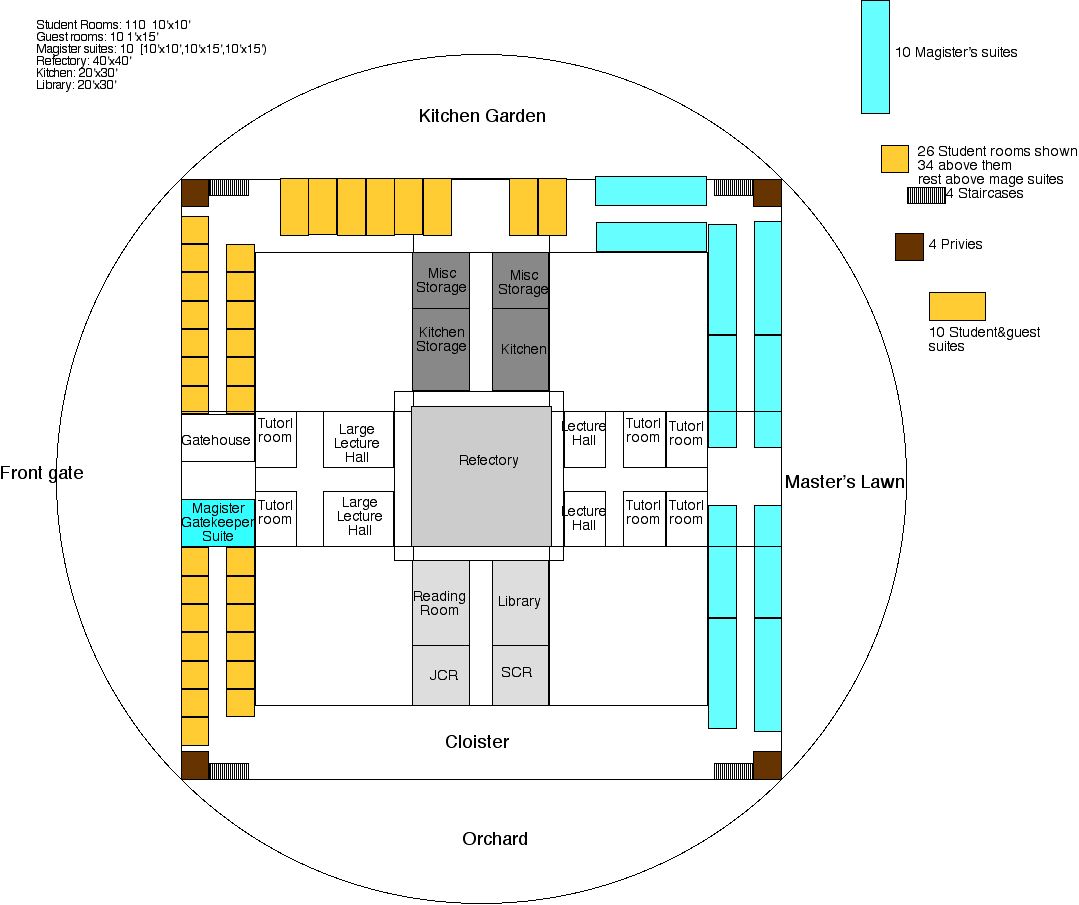
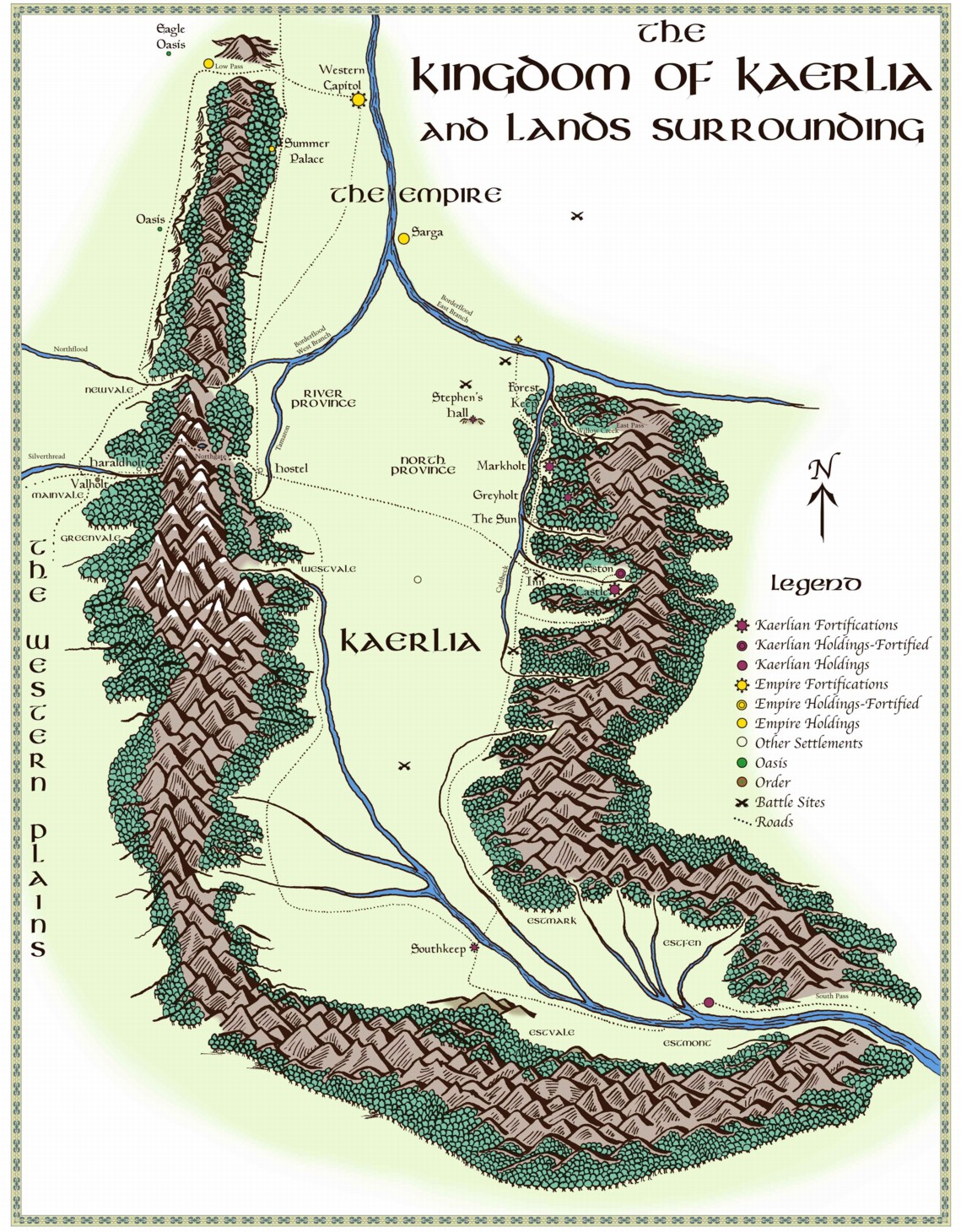
The Map from Salamander

The map of the College is now up. Not nearly as nice as the map for Harald, which was done for me by a generous professional, but at least it shows where everything is.